Feel like quitting the gym?
Last year in July, I cancelled my gym membership.
Something wasn’t feeling right going there. I loved the equipment and the community.
Yet in the background, little did I know there was an accumulation of factors piling up that left my intuition nudging me to pull the plug.
First, it was the cleaning solution used to wipe down the equipment. I found it to be a strong scent, and all my spidey senses only sensed harsh toxic chemicals.
Then, it was the loud music. Depending on the fitness coach on staff, it would be heavy metal or top 40, which neither is my thing, especially at 6am.
The icing on the cake for me was the bright fluorescent lights and pungent air fresheners and perfumes in the change room.
Everything felt unnatural–disturbing for my nervous system.
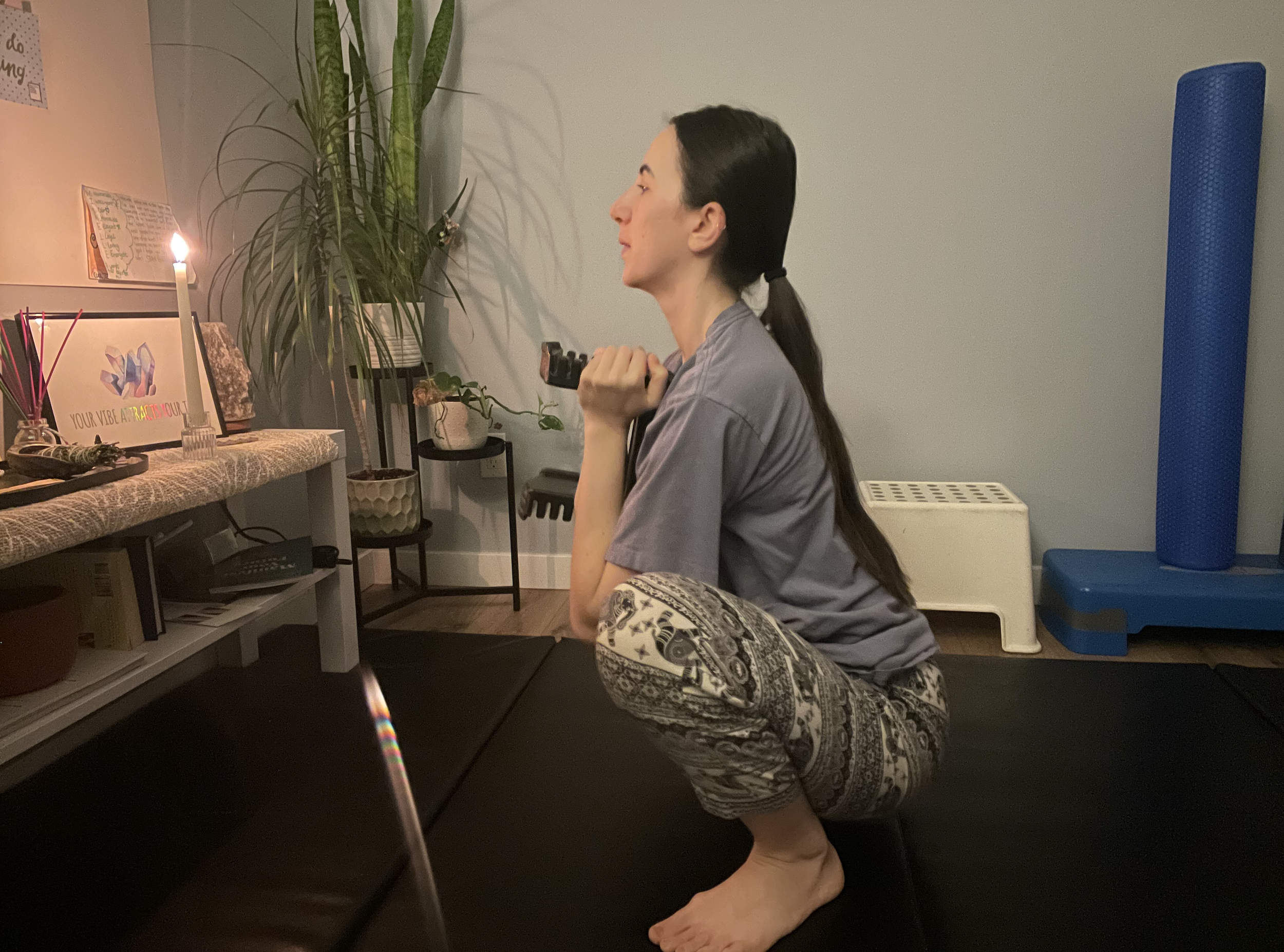
I decided to create my ideal workout environment at home. It’s simple– adjustable dumbbells, a thick mat, a bench and some other gadgets.
Instead of music, I embrace silence.
Instead of bright fluorescent lights, I enjoy the sun or a candlelight.
Instead of harsh scents and chemicals, I lean on unscented living and vinegar cleaning solution.
Have you ever felt this way in a gym?
You’re not alone and far from crazy.
Here is a breakdown of why that environment can feel a bit disconnected from our biology:
1. The Sensory Environment
Our bodies evolved to respond to the natural rhythms of the earth, but gyms often provide the exact opposite:
Artificial Lighting: Most gyms rely on high-intensity fluorescent or LED lighting. These lack the full spectrum of sunlight and often flicker at frequencies that can trigger headaches or disrupt your circadian rhythm (especially during late-night sessions).
Recycled Air: High-density gyms often have poor ventilation. You’re essentially breathing in a cocktail of concentrated CO2 and "off-gassing" from others, rather than fresh, oxygen-rich outdoor air.
Constant Noise Pollution: Between the clanging iron, loud upbeat music, and humming cardio machines, your nervous system is often in a state of high-alert (sympathetic drive) rather than focused calm.
2. Chemical Exposure (The "Toxic" Load)
Because gyms are high-traffic areas, they require aggressive maintenance that isn't always "green":
Industrial Cleaners: To kill bacteria, most facilities use harsh quaternary ammonium compounds (quats) or bleach-based cleaners. These linger in the air and on surfaces, where they can be absorbed through your skin.
Synthetic Materials: Think about the gym floor. Most are made of recycled rubber or PVC, which can off-gas Volatile Organic Compounds (VOCs), especially in a warm, humid environment.
Fragrance & Body Care: In a small space, you're exposed to the synthetic fragrances of perfumes, deodorants, and laundry detergents from dozens of other people.
3. Biomechanical "Unnaturalness"
Even the way we move in a gym can be a bit strange compared to natural human movement:
Fixed Paths: Machines (like the Smith machine or leg extension) force your joints into a fixed, 2D plane of motion. In nature, movements are multi-planar and require stabilizing muscles to fire constantly.
Static Environments: Running on a treadmill (a moving belt that pulls your leg back for you) is biomechanically different from pushing off the solid, uneven ground of a trail.
The "Sedentary-to-Sprint" Cycle: Many people sit in a chair for 8 hours and then "shock" their bodies with 60 minutes of high-intensity gym work. This "active sedentary" lifestyle doesn't quite match the low-level, consistent movement humans are built for.
4. The Psychological Disconnect
Lack of "Green Exercise": Research consistently shows that "green exercise" (working out in nature) lowers cortisol levels more effectively than indoor exercise. In a gym, you’re often staring at a screen or a mirror rather than a horizon.
It’s a bit of a trade-off, isn't it? You get the convenience and the heavy weights, but you lose the "organic" connection to movement.
Now please remember, if you feel the gym environment is serving you well, embrace it! It served me for 17 years.
This is for the humans that feel resistant to workout at a gym, and perhaps these invisible factors many of us never considered are playing a role in the resistance.
Whatever moves you, keep leaning into that.